
Questão FC489724
Leia o texto a seguir para responder a questão. The research paper published in ‘Humanities & Social Sciences Communications’ — an open-access journal, distributed by Springer Natu
Questões sem classificação de assunto (Língua Inglesa (Inglês))
FGV · 2024
Leia o texto a seguir para responder a questão.
The research paper published in ‘Humanities & Social Sciences Communications’ — an open-access journal, distributed by Springer Nature — examines the impact of AI on “loss in decision- making and privacy concerns among university students in Pakistan and China”.
The rise of AI has also exposed students and teachers to a number of challenges, particularly data hacking and systemic and racial biases. “Many people are now concerned with the ethical attributes of AI systems and believe that the security issue must be considered in AI system development,” the researchers claimed. In order to mitigate safety concerns, the paper said there was a need to “continuously re-evaluate and re-design” security practices. However, academia is poorly equipped to deal this issue due to a shortage of funding and technical staff. “No one can run from the threat of AI concerning cybersecurity, it behaves like a double-edged sword.”
As per the research, AI has the potential to revolutionise the education sector but with certain drawbacks. In order to effectively harness this technology, the paper called for steps to ensure AI does not cause at least “severe ethical concerns”, and technology backed by secure algorithms to ensure data security and minimisation of AI’s bias. It also recommended measures to curtail overreliance on AI to address “laziness” and cognitive deficiency.
ABBAS, Zaki. AI making students lazy, impairing cognition: study. Disponível em:
https://www.dawn.com/news/1759121/ai-making-students-lazy-impairing- cognition-study. Acesso em: 12 jul. 2024. Adaptado.
Leia o cartoon a seguir.
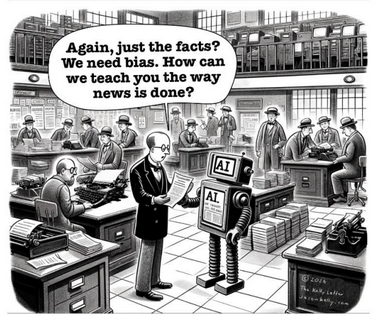
Considere o seguinte trecho do texto apresentado acima: “In order to effectively harness this technology, the paper called for steps to ensure AI does not cause at least “severe ethical concerns”, and technology backed by secure algorithms to ensure data security and minimisation of AI’s bias”.
Ao relacionar as informações trazidas pelo texto e a fala do homem no cartoon, pode-se inferir corretamente que
- as informações geradas pelas IA’s são factuais e livres de preconceito.
- as notícias escritas em colaboração com as IA’s costumam ser imparciais.
- o enviesamento das IA’s advém da interferência humana ao programá-las.
- a interferência humana nas IA’s elimina qualquer possibilidade de preconceito.
- o enviesamento é uma característica humana que não pode ser transmitida a uma IA.
Mostrar resposta e comentário
Gabarito
Certo
Comentário do professor
A afirmação é correta porque o enviesamento em sistemas de IA não surge por mágica, mas decorre das escolhas humanas durante seu desenvolvimento.
Os modelos aprendem a partir de dados fornecidos por pessoas; se esses conjuntos refletem preconceitos históricos ou amostragens desequilibradas, o sistema reproduzirá esses padrões.
Além disso, decisões de programação — como seleção de variáveis, rotulagem, definição de objetivos e métricas — incorporam valores e prioridades humanas que orientam o comportamento da IA.
Feedbacks do uso real também amplificam vieses quando não há correções. Por isso, reduzir o viés exige práticas humanas responsáveis: curadoria de dados, testes, transparência e auditoria contínua.
Conteúdo do catálogo FC Concursos · Atualizado em