
Questão FC586289
When discussing the typical sequence of an English language lesson, Scrivener (2011), proposes the following diagram: Source: Scrivener (2011, p. 159). You, as an English language
Interpretação de Textos (Understanding)
Instituto AOCP · 2023
When discussing the typical sequence of an English language lesson, Scrivener (2011), proposes the following diagram:
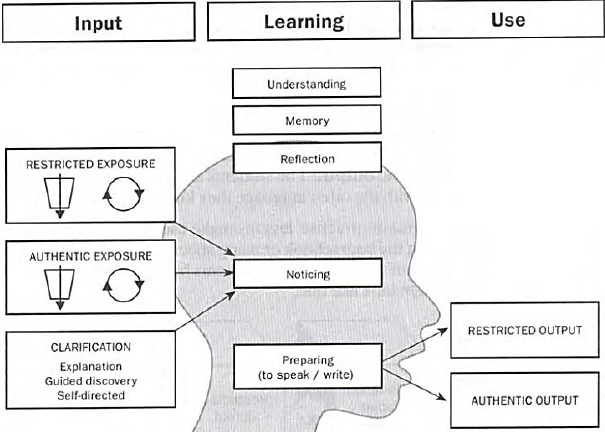
Source: Scrivener (2011, p. 159).
You, as an English language teacher, establishes that your group’s following communicative objective is to make predictions about the future. In order to achieve that, you decide to work with the article Bing A.I. and the Dawn of the Post-Search Internet to develop reading skills and also to work with the structure Future Simple with Will to make future predictions. Considering this classroom situation and Scrivener’s diagram, analyze the following statements.
I. The article functions as input material, once students are exposed to the target language, in this case, will for future predictions.
II. The teacher draws students’ attention to part of the text and asks students to find one prediction the author is making about the future. Students identify it. This step of the lesson is what Scrivener calls self-directed clarification in his diagram, once students work completely autonomously, without the teacher’s intervention.
III. The teacher draws students’ attention to other two model sentences of future prediction from the text. Then, the teacher asks questions such as Are we talking about a present, past or future situation?; How do you know it’s future?; So when we want to make a prediction about the future, what do we use?. This is what Scrivener calls, in his diagram, guided-discovery clarification and the questions used by the teacher are called concept-checking questions.
IV. The teacher carries out some drilling exercises to systematize the target language. Then, the teacher asks students to produce an infographic making predictions for the future. The first practice, the drilling exercises, is what Scrivener calls in his diagram authentic output, or freer practice, while the infographic is what he calls restricted output, or controlled practice.
It is completely accurate what is stated in
- II, III and IV only.
- I, II and III only.
- I and IV only.
- II and IV only.
- I and III only.
Mostrar resposta e comentário
Gabarito
Errado
Comentário do professor
A assertiva I está correta porque o artigo funciona como input: ao expor os alunos ao texto os estudantes encontram ocorrências de Future Simple with will em contexto real, o que favorece a percepção da forma e do uso para fazer previsões.
A assertiva III também está correta porque a sequência descrita corresponde à etapa de guided-discovery clarification de Scrivener. Ao destacar duas frases-modelo e fazer perguntas do tipo "Estamos falando de presente, passado ou futuro?" ou "Como você sabe que é futuro?", o professor orienta a observação e leva os alunos a inferir regras.
Essas perguntas são concept-checking questions, utilizadas para confirmar entendimento da forma e do significado antes que os alunos pratiquem a estrutura de maneira mais livre.
Conteúdo do catálogo FC Concursos · Atualizado em