
Questão FC699654
Overemphasis on mastery of what we imagine to be the basic structures of the language has frequently resulted in language teaching greatly overstressing usage. Many sentences occur
Interpretação de Textos (Understanding)
VUNESP · 2024
Usage and use
The distinction, first made by Widdowson, focuses attention on language used to perform communicative acts, rather than simply to exemplify possible well-formed sentences in the language. He coined the term usage for language which conformed to the codified paradigms of language. Usage is independent of context, and allows us to say that a sentence is a possible English sentence. It gives us no information at all about the context in which it is appropriate.
In contrast, use describes the functional and contextual appropriacy of an utterance. It has to do with the speaker’s intention in producing a particular sentence. Except in language teaching, sentences are not produced as exemplifications of the language, but in order to achieve purposes. “I don’t know what you mean”, said in a particular way and in a particular context, may imply a request for clarification; in this case, the use reflects the surface meaning of the words. Equally, the same sentence said in a different way and in a different context may be an expression of disbelief or even outrage. In this case, the pragmatic meaning – the purpose that the speaker intends – is not reflected in surface meaning.
Overemphasis on mastery of what we imagine to be the basic structures of the language has frequently resulted in language teaching greatly overstressing usage. Many sentences occurred in textbooks, and were used in grammar pratices which were well-formed sentences. However, can you think of a real-life situation in which a sentence such as “This is my hand” is uttered?
(LEWIS, M. The lexical approach. Heinle Cengage, 2010. Adaptado)
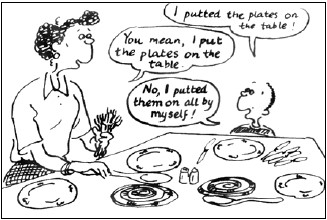
Read the cartoon and compare it to the content in the text “Use and usage”.
(P.M. Lightbown & N.Spada. How languages are learned. Oxford, OUP. 2013. 4th edition)
The reading of the text and the cartoon allows for the following statement:
- The line “No, I putted them on all by myself” indicates the boy is worried about context meaning rather than about usage.
- The boy’s intention in producing his utterance seems to have been misunderstood by the mother.
- Well-formed sentences are not necessary for real-life language communication to take place.
- When correcting his son’s words, the mother focused on usage and somehow ignored pragmatic meaning.
- The boy’s persistent grammar error illustrates the difficulty in mastering language norms.
Mostrar resposta e comentário
Gabarito
D
Comentário do professor
A alternativa aponta que a mãe corrigiu a fala do filho privilegiando o usage, ou seja, a conformidade com normas e formas linguísticas isoladas.
Segundo o texto, usage refere-se a sentenças bem-formadas independentemente do contexto. Já o use envolve a intenção comunicativa e a adequação situacional.
No cartoon a mãe repreende a forma verbal, sem considerar o que o filho pretendia comunicar. Assim, ela ignora o significado pragmático da fala, isto é, o propósito ou emoção por trás da utterance.
Em resumo, a correção foca a estrutura e não a função comunicativa; por isso a alternativa D é correta: a mãe privilegiou usage e desconsiderou o significado pragmático.
Conteúdo do catálogo FC Concursos · Atualizado em