
Questão FC699864
Leia o texto para responder à questão. They power tiny phones and two-tonne electric cars. They form the guts of a growing number of grid-storage systems1 that smooth the flow of e
Semântica e Significado de Vocábulos (Semantics)
VUNESP · 2024
Leia o texto para responder à questão.
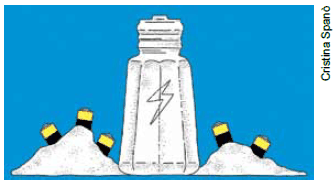
They power tiny phones and two-tonne electric cars. They form the guts of a growing number of grid-storage systems1 that smooth the flow of electricity from wind and solar power stations. Without them, the electrification needed to avoid the worst effects of global warming would be unimaginable.
But lithium-ion (Li-ion) batteries have downsides. Lithium is scarce, for one. And the best Li-ion batteries, those with layered-oxide cathodes, also require cobalt and nickel. These metals are scarce, too — and cobalt is also problematic because a lot of it is mined in the Democratic Republic of Congo, where working conditions leave much to be desired. A second sort of Li-ion battery, a so-called polyanionic design that uses lithium iron phosphate (LFP), does not need nickel or cobalt. However, such batteries cannot store as much energy per kilogram as layered-oxide ones.
A group of companies, though, think they have an alternative: making batteries with sodium instead. Unlike lithium, sodium is abundant: it makes up most of the salt in the oceans. And chemists have found that layered-oxide cathodes which use sodium rather than lithium can get by without cobalt or nickel to increase their quality. The idea of making sodium-ion (Na-ion) batteries at scale is therefore gaining traction. Engineers are adjusting designs. Factories, particularly in China, are springing up. For the first time since the Li-ion revolution began, lithium’s place on the electrochemical pedestal is being challenged.
(www.economist.com, 25.10.2023. Adaptado.)
1 grid-storage system: sistema de armazenamento de energia elétrica.
In the excerpt from the third paragraph “Factories, particularly in China, are springing up”, the underlined expression means
- splitting.
- closing.
- modernizing.
- moving.
- emerging.
Mostrar resposta e comentário
Gabarito
Errado
Comentário do professor
To spring up é um phrasal verb que significa surgir de repente ou aparecer rapidamente. No contexto, indica a criação e multiplicação de fábricas num curto espaço de tempo.
Emerging é o gerúndio de to emerge, que quer dizer surgir ou vir à tona. Tem o mesmo sentido de algo que começa a existir ou se tornar visível.
No enunciado, “Factories, particularly in China, are springing up.” pode ser entendida como “Fábricas... estão surgindo rapidamente.” Substituir por “are emerging” mantém o mesmo significado: novas fábricas estão aparecendo e ganhando importância.
Conteúdo do catálogo FC Concursos · Atualizado em