
Questão FC700070
Leia o texto para responder a questão. If styles are general characteristics that differentiate one individual from another, then strategies are those specific “attacks” that we ma
Sem classificação
VUNESP · 2025
Leia o texto para responder a questão.
If styles are general characteristics that differentiate one individual from another, then strategies are those specific “attacks” that we make on a given problem, and that vary considerably within each individual. They are the momentby-moment techniques that we employ to solve “problems” posed by second language input and output. Chamot (2005, p. 112) defines strategies quite broadly as “procedures that facilitate a learning task. Strategies are most often conscious and goal driven.”
As our knowledge of second language acquisition increased markedly during the 1970s, teachers and researchers came to realize that no single research finding and no single method of language teaching would usher in an era of universal success in teaching a second language. We saw that certain learners seemed to be successful regardless of methods or techniques of teaching. We began to see the importance of individual variation in language learning.
Certain people appeared to be endowed with abilities to succeed; others lacked those abilities. This observation led Rubin (1975) and Stern (1975) to describe “good” language learners in terms of personal traits, styles, and strategies.
Rubin (Rubin & Thompson, 1982) later summarized fourteen such characteristics. Among other abilities, good language learners tend to:
1. Find their own way, taking charge of their learning
2. Be creative and develop a “feel” for the language by experimenting with its grammar and words
3. Make their own opportunities for practice in using the language inside and outside the classroom
4. Learn to live with uncertainty by continuing to talk or listen without understanding every word
5. Use linguistic knowledge, including knowledge of their first language, in learning a second language
6. Use contextual cues to help them in comprehension
7. Learn to make intelligent guesses
8. Learn chunks of language as wholes and formalized routines to help them perform “beyond their competence”
9. Learn different styles of speech and writing and learn to vary their language according to the formality of the situation.
(, H.Douglas Brown. Principles of language learning and teaching. 5th ed. Longman, 2000. Adaptado)
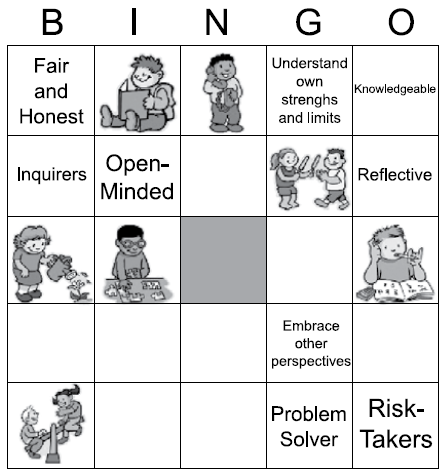
Leia a gravura e compare-a ao conteúdo do texto de Brown (2000).
(https://bingobaker.com)
The space in the bingo card that best represents learners who “Learn to live with uncertainty by continuing to talk or listen without understanding every word” (item 4 in Brown’s list of strategies”) is the one which reads
- knowledgeable.
- inquirers.
- reflective.
- risk-takers.
- embrace other perspectives.
Mostrar resposta e comentário
Gabarito
D
Comentário do professor
Risk-takers correspondem diretamente à ideia de learn to live with uncertainty by continuing to talk or listen without understanding every word. Esse perfil inclui aprendentes que aceitam a possibilidade de erro e seguem comunicando-se mesmo frente a lacunas de vocabulário ou compreensão.
Ao agir como risk-takers, o aluno continua participando, formulando hipóteses, tentando palavras desconhecidas e usando o contexto para entender e ser entendido. Essa postura favorece a prática oral, a recepção de feedback e a automatização de padrões linguísticos.
Em suma, ser risk-taker significa tolerar a incerteza comunicativa e transformar essa exposição em oportunidade de aprendizagem, exatamente o comportamento descrito no item 4 da lista de Brown.
Conteúdo do catálogo FC Concursos · Atualizado em