
Questão FC700171
Leia o texto para responder à questão. Newspaper sales have been in decline for decades, and most Americans now prefer to get news from digital devices. In this environment, many n
Sem classificação
VUNESP · 2025
Leia o texto para responder à questão.
Newspaper sales have been in decline for decades, and most Americans now prefer to get news from digital devices. In this environment, many news organizations — and not just newspapers — put paywalls1 on their websites or apps, blocking access to articles or other content unless news consumers pay or subscribe.
The vast majority of Americans (83%) say they have not paid for news in 2024, according to a survey. Another 17% say they have directly paid or given money to a news source by subscribing, donating or becoming a member during that time.
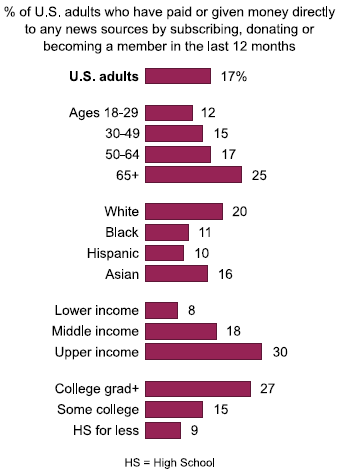
Among the 83% of United States (U.S.) adults who have not paid for news in 2024, the most common reason they cite is that they can find plenty of other news articles for free. About half of those who don’t pay for news (49%) say this is the main reason.
Another common reason people don’t pay for news is that they are not interested enough (32%). Smaller shares of Americans who don’t pay for news say the main reason is that it’s not affordable (10%) or that the news provided isn’t good enough to pay for (8%).
(Emily Tomasik and Michael Lipka. www.pewresearch.org. Adaptado.)
1 paywalls: programs that stop people who have not paid a subscription from using a website.
According to the fourth paragraph, 10% of Americans who don’t pay for news
- consider that the costs of paid news outlets are too expensive.
- claim they dislike to follow the news on a daily basis.
- emphasize that paid sources of news are unreliable.
- say they have stopped watching the news a long time ago.
- believe that paid sources of news offer better content.
Mostrar resposta e comentário
Gabarito
A
Comentário do professor
A alternativa correta indica que 10% dos americanos que não pagam por notícias consideram que o serviço é muito caro.
No quarto parágrafo do texto aparece explicitamente a expressão em inglês "not affordable (10%)", que corresponde diretamente à ideia de que as assinaturas ou conteúdos pagos estão fora do alcance financeiro desse grupo.
Portanto, a afirmação de que esses 10% consideram os custos das fontes de notícias pagas excessivos é uma interpretação literal e fiel ao enunciado do texto.
Importante notar que esse percentual se refere apenas à parcela dos adultos dos EUA que optaram por não pagar por notícias em 2024.
Conteúdo do catálogo FC Concursos · Atualizado em