
Questão FC700182
Leia o texto e examine as imagens para responder à questão. In 2024, Brazil, the world’s largest exporter of soya and corn, faced one of the worst droughts in its recent history. A
Sem classificação
VUNESP · 2025
Leia o texto e examine as imagens para responder à questão.
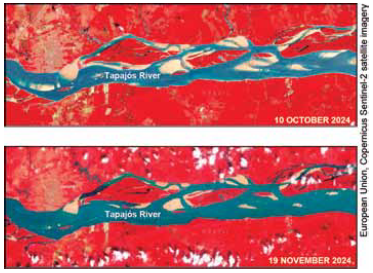
In 2024, Brazil, the world’s largest exporter of soya and corn, faced one of the worst droughts in its recent history. Among the worst affected rivers is the Tapajós, a key artery for grain trade from the state of Mato Grosso, the beating heart of Brazil’s agricultural production.
In October, its water level reached historic lows, forcing the traffic suspension of boats for goods transport. Copernicus Sentinel-2 satellite images clearly show the impact of the crisis. In the image acquired on 10 October, large areas of sand can be seen in the riverbed, a sign of the drastic reduction in water levels. Thanks to the November rains, the river has partially regained its flow, as shown in the image dated 19 November, allowing river transport to resume at 50 per cent of its capacity.
The Copernicus Global Drought Observatory (GDO) monitors and provides data on global drought conditions to support water resource management and emergency response.
(www.copernicus.eu, 02.12.2024. Adaptado.)
According to the text and the images, on November 19, 2024, the Tapajós River
- recovered in part to permit half of its transport volume.
- regained its flow after the seasonal floods in October.
- could be fully navigated to transport people and grains.
- still needed much rain to overflow and compensate the losses.
- was back to its lowest level, considering the period of the year.
Mostrar resposta e comentário
Gabarito
A
Comentário do professor
Recuperou-se parcialmente indica que o nível de água não voltou ao normal, mas aumentou o suficiente para recompor parte da navegação.
O enunciado e as imagens de satélite mostram leito exposto em 10 de outubro e, após as chuvas, maior volume em 19 de novembro de 2024. Essa comparação visual confirma a restauração parcial do fluxo.
A expressão "permitir metade do seu volume de transporte" corresponde à informação de que o tráfego fluvial foi retomado em 50% da capacidade, ou seja, apenas metade dos embarques anteriores ao desastre pôde ser realizada.
Portanto, em 19 de novembro a situação do Tapajós era de recuperação parcial, comprovada por imagens e relatórios, suficiente para retomar o transporte em metade da capacidade habitual.
Conteúdo do catálogo FC Concursos · Atualizado em