
Questão FC700183
Leia o texto e examine as imagens para responder à questão. In 2024, Brazil, the world’s largest exporter of soya and corn, faced one of the worst droughts in its recent history. A
Sem classificação
VUNESP · 2025
Leia o texto e examine as imagens para responder à questão.
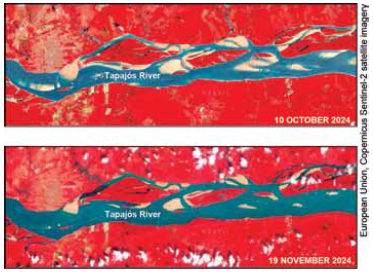
In 2024, Brazil, the world’s largest exporter of soya and corn, faced one of the worst droughts in its recent history. Among the worst affected rivers is the Tapajós, a key artery for grain trade from the state of Mato Grosso, the beating heart of Brazil’s agricultural production.
In October, its water level reached historic lows, forcing the traffic suspension of boats for goods transport. Copernicus Sentinel-2 satellite images clearly show the impact of the crisis. In the image acquired on 10 October, large areas of sand can be seen in the riverbed, a sign of the drastic reduction in water levels. Thanks to the November rains, the river has partially regained its flow, as shown in the image dated 19 November, allowing river transport to resume at 50 per cent of its capacity.
The Copernicus Global Drought Observatory (GDO) monitors and provides data on global drought conditions to support water resource management and emergency response.
(www.copernicus.eu, 02.12.2024. Adaptado.)
According to the text, the importance of the Tapajós River is attributed to its
- length and historical relevance.
- ability to recover from severe droughts.
- boat traffic to transport grain production.
- water to irrigate corn and soya crops.
- riverbed quality and depth for commercial navigation.
Mostrar resposta e comentário
Gabarito
Certo
Comentário do professor
A alternativa correta destaca que a importância do Tapajós está relacionada ao tráfego de barcos destinado ao escoamento de grãos. No texto fica explícito que o rio é "uma artéria chave para o comércio de grãos" vindo de Mato Grosso, região central da produção agrícola brasileira.
As imagens de satélite e a descrição da crise hídrica mostram que a queda do nível da água expôs bancos de areia e levou à suspensão do transporte. Isso confirma o papel logístico do rio na circulação de soja e milho.
Quando as chuvas retornaram, o texto informa que o transporte fluvial foi restabelecido em 50%, evidenciando a dependência da produção agrícola pelo tráfego de embarcações no Tapajós.
Conteúdo do catálogo FC Concursos · Atualizado em