
Questão FC700347
Leia o texto e examine o mapa para responder à questão. Global literacy today Of the world population older than 15 years, the majority are literate, that is to say, can read and w
Sem classificação
VUNESP · 2024
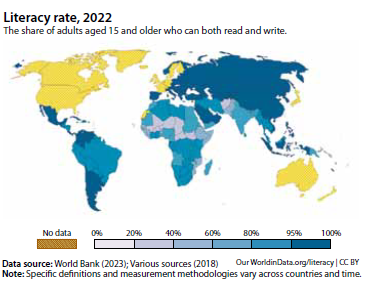
Leia o texto e examine o mapa para responder à questão.
Global literacy today
Of the world population older than 15 years, the majority are literate, that is to say, can read and write.
This map shows how literacy rates vary around the world. In many countries, more than 95% have basic literacy skills. Literacy skills of the majority of the population are a modern achievement. Globally, however, large inequalities continue. In some countries in sub-Saharan Africa, less than 1-in-3 adults (aged over 15 years) are able to both read and write.
Historical change in literacy
While the earliest forms of written communication date back to about 3,500–3,000 before the Christian era, for centuries literacy remained a very restricted technology closely associated with the exercise of power. It was only during the Middle Ages that book production started growing, and literacy among the general population slowly started becoming important in the Western World. However, it took centuries for universal literacy to happen. It was only in the 19th and 20th centuries that rates of literacy approached universality in early-industrialized countries.
(Max Roser e Esteban Ortiz-Ospina, 03.2023. https://ourworldindata.org/ literacy. Acesso em 14.09.2024. Adaptado.)
According to the last paragraph,
- the first manifestations of written language come from around five thousand years ago.
- literacy is more and more associated with technology and the exercise of power nowadays.
- knowing how to read and write has always been an important universal objective.
- literacy became universal immediately after large book production started.
- literacy was particularly widespread during the Middle Ages.
Mostrar resposta e comentário
Gabarito
A
Comentário do professor
O último parágrafo afirma que as «earliest forms of written communication date back to about 3,500–3,000 before the Christian era». Isso indica explicitamente uma origem das primeiras manifestações da escrita entre 3.500 e 3.000 a.C., conforme o texto.
Converter esse intervalo para contagem decorrido significa situá‑lo em torno de cinco mil anos atrás. Logo, a alternativa que afirma que as primeiras manifestações da linguagem escrita surgem por volta de cinco mil anos atrás é correta, pois traduz de forma equivalente o período cronológico indicado pelo autor.
Conteúdo do catálogo FC Concursos · Atualizado em